
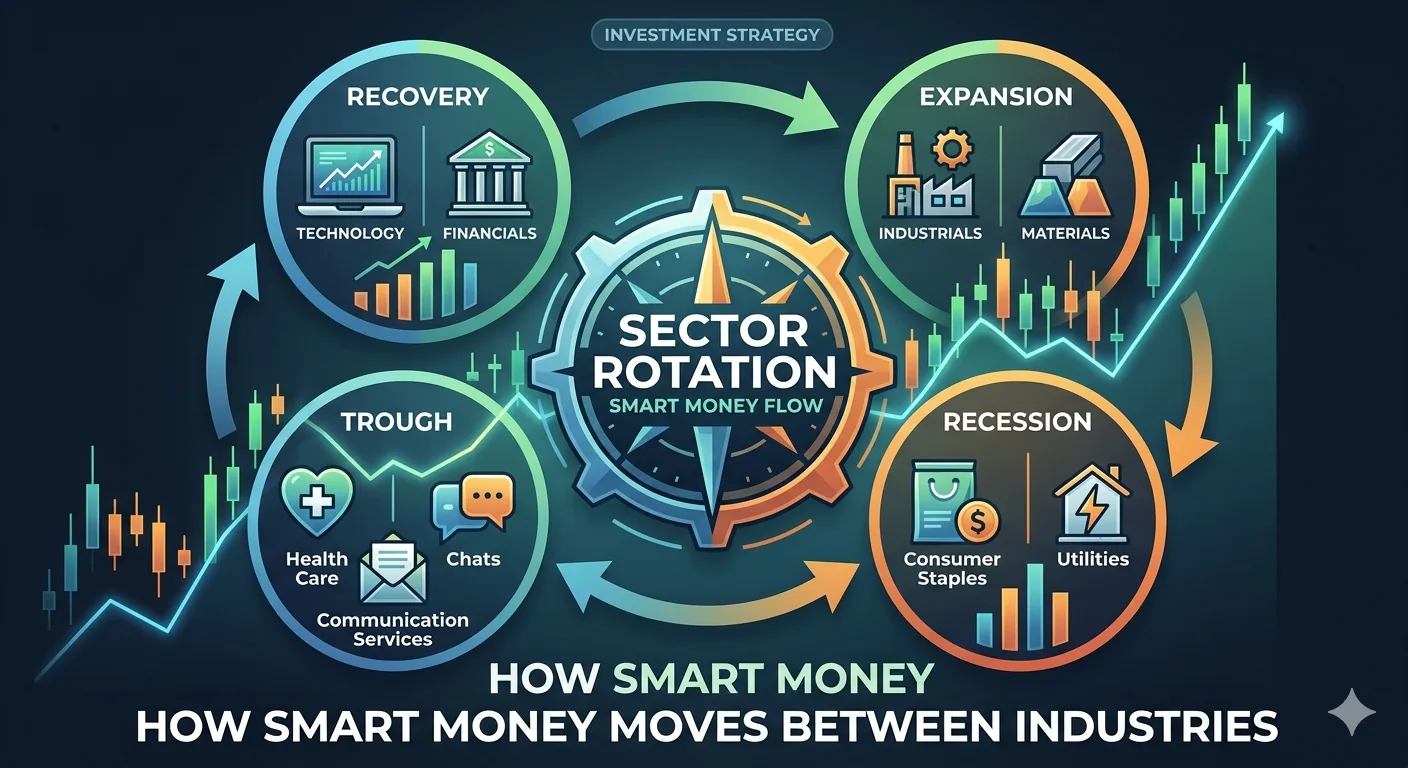
Why does money flow from IT to banks to FMCG and back? Understand sector rotation, the economic cycle, and what it means for your portfolio.
Ever notice how, for a stretch of months, IT stocks seem unstoppable while banks lag — and then, almost as if a switch flipped, banks surge while IT cools? That's not random. It's a phenomenon called sector rotation, and understanding it helps explain why different parts of the market take turns leading. You don't need to trade it like a professional to benefit from understanding it; even a long-term investor makes better decisions knowing why their portfolio behaves the way it does.
What sector rotation is
Not all sectors of the economy rise and fall together. At any given time, money tends to flow toward the sectors expected to do well in the current phase of the economic cycle and away from those expected to struggle. As conditions change, large institutional investors rotate their money from one group of sectors to another. This rotation is one of the forces behind why leadership in the market keeps changing hands.
The key insight: sectors are sensitive to the economy in different ways. Some thrive when the economy is booming. Others hold up best when it's struggling. Smart money positions ahead of these shifts.
Cyclical vs defensive: the basic divide
Before the cycle itself, you need this one distinction:
Cyclical sectors rise and fall sharply with the health of the economy. When people and businesses are confident and spending, these boom. When the economy contracts, they suffer most. Think of sectors tied to discretionary spending and big-ticket decisions — autos, real estate, metals, consumer durables, and to a degree banking and industrials. People buy cars and houses when times are good and postpone them when times are uncertain.
Defensive sectors sell things people need no matter what the economy is doing. You still buy soap, medicine, and electricity in a recession. So sectors like FMCG (consumer staples), pharmaceuticals, and utilities tend to be steadier — they don't soar as high in booms, but they don't crash as hard in downturns. They're the portfolio's shock absorbers.
The economic cycle and who leads each phase
Economies move in broad cycles — roughly: early recovery, expansion/peak, slowdown, and recession/trough — and different sectors tend to lead in each. While the real world is messier than any neat model, the general pattern looks like this:
Early recovery (coming out of a downturn): Interest rates are typically low and optimism is returning. Rate-sensitive and cyclical sectors often lead — banks and financials (lending picks up), along with sectors geared to recovering demand.
Expansion / peak (economy running hot): Confidence and spending are high. Cyclicals like industrials, metals, and consumer discretionary tend to do well as demand and capacity utilization rise.
Slowdown (growth cooling, often rates high): Investors grow cautious. Money often begins shifting toward quality and defensives, anticipating tougher times ahead.
Recession / trough (economy contracting): Defensive sectors — FMCG, pharma, utilities — typically hold up best because their demand is stable. They protect capital while everything cyclical struggles.
Then the cycle turns again, and leadership rotates back toward cyclicals as recovery begins. This is the wheel that keeps turning.
Reading the signals (without pretending to be a fortune-teller)
How do investors anticipate rotation? They watch the big-picture signals that drive the cycle: the direction of interest rates, inflation trends, economic growth data, and corporate earnings. Falling interest rates, for instance, often favor rate-sensitive sectors; rising inflation can favor commodities and hurt others. These are clues about which phase the economy is entering — and therefore which sectors may be moving into or out of favor.
But here's the essential caveat: timing rotation precisely is extremely hard, even for professionals. The economy doesn't announce which phase it's in, signals are noisy and often conflicting, and the market frequently moves before the data confirms anything. Anyone who claims to call these turns reliably should be treated with healthy skepticism.
What this means for your portfolio
You don't need to aggressively chase rotation to use this knowledge. A few practical takeaways:
- It explains diversification's value. Because sectors take turns leading, a portfolio spread across both cyclical and defensive sectors is steadier than one concentrated in whatever is hot right now. When one zigs, another zags.
- It tempers FOMO. When one sector is soaring and you feel you're missing out, remember leadership rotates. Chasing last year's winner near its peak is how many investors buy high.
- It frames professional research properly. Understanding which phase we may be in, and which sectors are positioned for it, is exactly the kind of analysis where genuine, disclosed research adds value over reacting to headlines.
- It rewards patience. The sector dragging on your portfolio today may be tomorrow's leader. Wholesale dumping of an out-of-favor sector at the bottom is often the opposite of what rotation logic suggests.
The bottom line
Sector rotation is the market's way of taking turns. As the economy cycles through recovery, expansion, slowdown, and contraction, money flows toward the sectors suited to each phase — cyclicals in the good times, defensives when caution sets in. You don't need to trade every turn to benefit from understanding it. Knowing that leadership rotates makes you a calmer, more diversified, less FOMO-driven investor — and that's an edge in itself.
Just remember: the broad logic is reliable, but the precise timing is not. Treat the cycle as a map of the terrain, not a guarantee of the route.
Explore verified SEBI RA's - https://kuberhunt.com/experts
This article is for educational and informational purposes only and does not constitute investment advice. Sector and economic frameworks are general and simplified; actual market behavior is complex and uncertain. Consult a qualified, SEBI-registered professional before making investment decisions.