
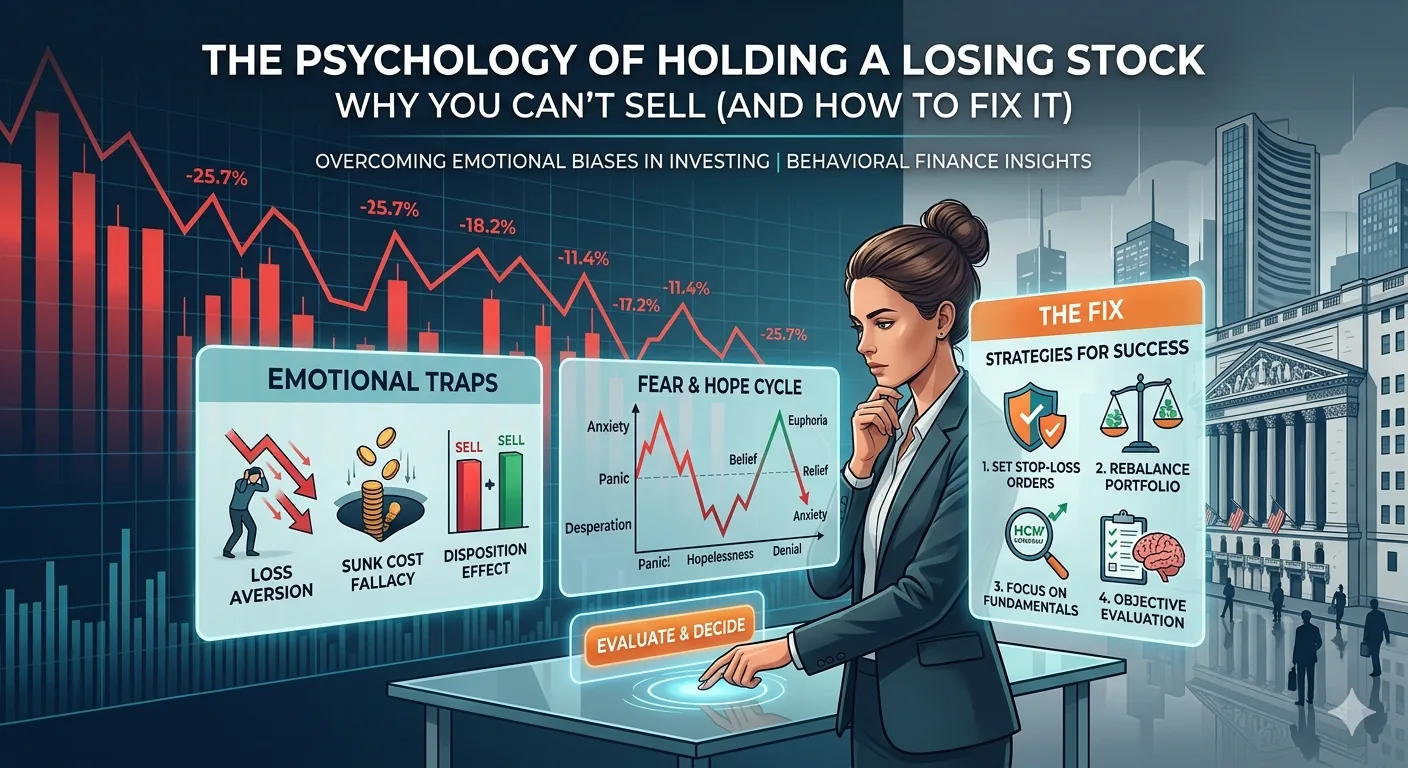
Loss aversion, the sunk-cost trap, and the "it'll come back" lie. Understand the behavioral biases that keep you stuck in bad trades — and how to break free.
You bought a stock at ₹500. It's now at ₹350. You know, somewhere rational in your mind, that you should probably cut it loose. But you don't. You hold. You wait. You check the price ten times a day, willing it back to ₹500 so you can "exit at break-even." Months pass. It's at ₹280 now.
If this feels uncomfortably familiar, you're not weak or stupid. You're human — and your brain is running a set of ancient programs that were never designed for the stock market. Understanding these biases is the first step to overriding them.
Loss aversion: why losses hurt twice as much
Decades of behavioral research have shown something striking: the pain of losing money is roughly twice as powerful as the pleasure of gaining the same amount. Losing ₹10,000 hurts far more than making ₹10,000 feels good.
This asymmetry distorts everything. Because realizing a loss is so painful, your brain desperately avoids it. As long as you hold the losing stock, the loss is only "on paper" — it doesn't feel fully real. The moment you sell, it becomes a permanent, concrete failure. So you hold, not because holding is the smart financial decision, but because selling forces you to feel the pain you're wired to avoid.
The cruel irony: this instinct, which evolved to protect us, often makes the loss bigger.
The disposition effect: selling winners, riding losers
Here's a pattern researchers see again and again in retail investors: they sell their winning stocks too early and hold their losing stocks too long. It's called the disposition effect, and it's loss aversion in action.
When a stock is up, you feel the urge to "lock in the gain" before it disappears — so you sell, often cutting off a winner that had much further to run. When a stock is down, you refuse to sell because that would make the loss real — so you hold a loser that keeps falling. The result is a portfolio that systematically does the opposite of the old wisdom "cut your losses and let your winners run." You're letting your losses run and cutting your winners.
The sunk-cost fallacy: "I've already lost so much"
"I've already lost ₹1.5 lakh on this stock. I can't sell now — I'd be locking in the loss after coming this far."
This is the sunk-cost fallacy, and it's one of the most expensive sentences in investing. The money you've already lost is gone. It's sunk. It cannot be recovered by continuing to hold; it can only be recovered if the stock genuinely recovers on its own merits. The only question that matters is forward-looking: "Knowing what I know today, would I buy this stock right now at this price?" If the answer is no, then holding it is just a slow version of buying it — and you've already decided you wouldn't.
Your past losses should have zero influence on that decision. The market doesn't know or care what you paid.
Anchoring: chained to your buy price
Closely related is anchoring — your mind fixates on the price you paid (₹500) and treats it as some meaningful, magnetic level the stock "should" return to. But your purchase price is utterly irrelevant to the stock's future. The company doesn't know you bought at ₹500. Its future depends on its business, its industry, and its valuation today — not on your personal entry point. Waiting "until it gets back to what I paid" is anchoring dressed up as patience.
How to actually fix it
These biases are hardwired, so you can't simply "decide" to be rational in the heat of the moment. You have to build systems that make the decision before emotion takes over:
- Set a stop-loss when you buy, not after. Decide your exit point with a calm mind, before you're emotionally attached, and commit to it. This is the single most effective antidote.
- Ask the "would I buy it today?" question. Make it a rule. For any losing position, if you wouldn't buy it fresh at today's price, that's a strong signal to exit.
- Separate the decision from the dollar amount. Judge the position on its future prospects, not on how much you've already lost. Train yourself to ignore the sunk cost.
- Keep a journal. Write down why you bought each stock and your exit conditions. When emotions flare, your past, rational self is there to remind you of the plan.
- Size positions so no single loss is catastrophic. When a loss can't ruin you, you can think clearly about it. When it can, panic takes the wheel.
The bottom line
Holding a losing stock you should have sold isn't a knowledge problem — it's a psychology problem. The biases that trap you, loss aversion, the disposition effect, sunk cost, anchoring, are universal and powerful. You won't out-discipline them through willpower in the moment. You beat them by deciding in advance, writing it down, and following rules instead of feelings.
The best investors aren't the ones who never pick a loser. They're the ones who let go of their losers quickly, calmly, and without letting yesterday's mistake become tomorrow's bigger one.
Explore the verified SEBI RA's - https://kuberhunt.com/experts
This article is for educational and informational purposes only and does not constitute investment advice. It discusses general behavioral concepts and is not a recommendation to buy or sell any security. Consult a qualified, SEBI-registered professional before making investment decisions.