
It's one of the most common questions a new investor asks: should I just buy an index fund, or should I pick my own stocks? You'll find passionate people on both sides, often with something to sell. This article takes neither side blindly. Instead, it walks through what each approach really involves, what the evidence says, and how to decide what fits you.
It's one of the most common questions a new investor asks: should I just buy an index fund, or should I pick my own stocks? You'll find passionate people on both sides, often with something to sell. This article takes neither side blindly. Instead, it walks through what each approach really involves, what the evidence says, and how to decide what fits you.
What an index fund actually does
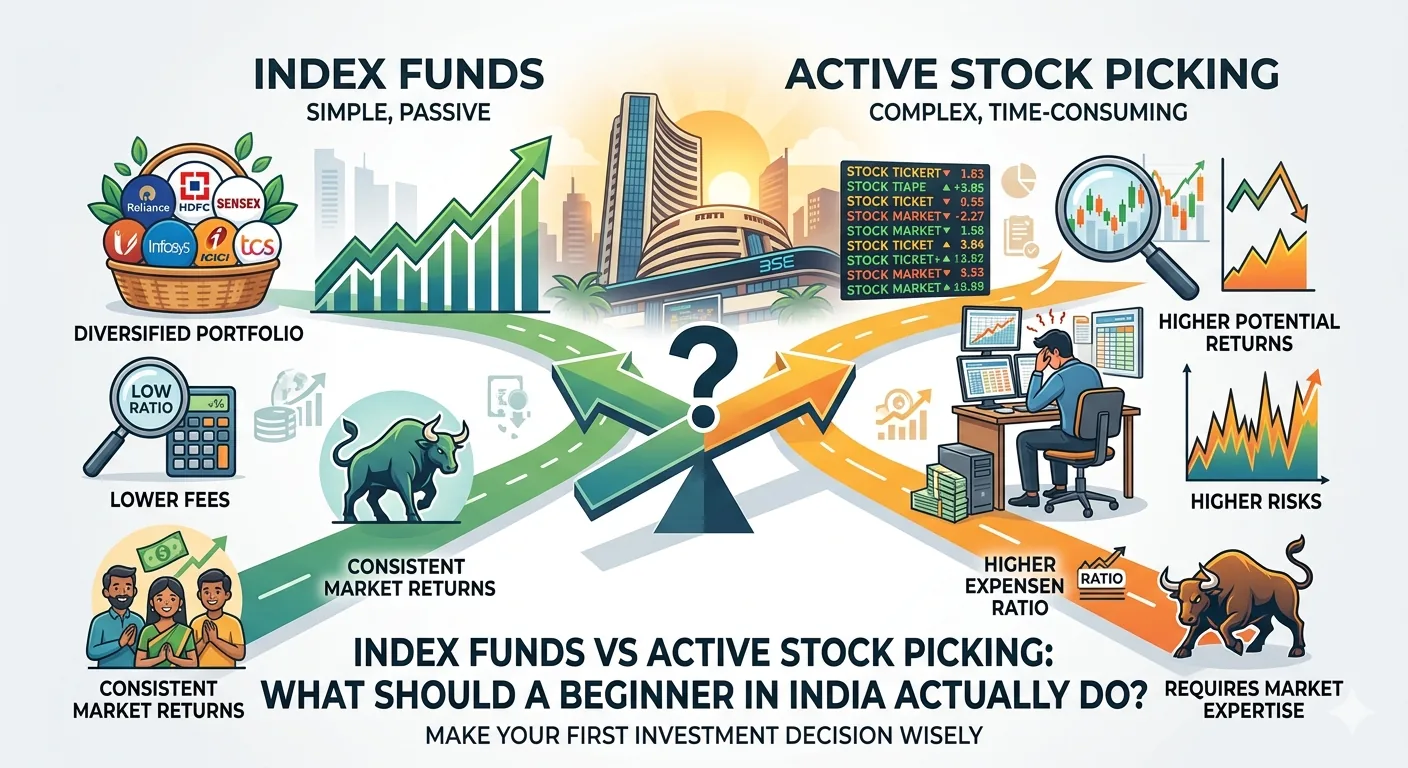
An index fund is beautifully simple. Instead of trying to pick winners, it buys the entire index — say, the Nifty 50 — in the same proportions. You own a tiny slice of all 50 companies. When the index goes up, you go up with it. When it falls, you fall with it.
The appeal is threefold. First, low cost — because no expensive analyst team is picking stocks, fees are minimal, and over decades low fees compound into a meaningful difference. Second, instant diversification — one purchase and you're spread across 50 large companies, so no single company's collapse sinks you. Third, simplicity — you don't need to research anything; you're just buying "the market."
The uncomfortable truth about active investing
Here's the finding that surprises beginners: over long periods, a large majority of active investors and professional fund managers fail to beat their benchmark index. Picking stocks that consistently outperform the market is genuinely hard — harder than the confident voices on social media suggest.
Why? Markets are competitive. Millions of smart, well-resourced participants are all trying to find the same bargains, which means obvious opportunities get priced away quickly. Add the costs — brokerage, taxes, the toll of bad timing and emotional decisions — and the average active investor often ends up behind the index they could have simply bought.
This isn't a reason to feel hopeless about stock-picking. It's a reason to be honest about the difficulty and to respect what you're up against.
So why pick stocks at all?
If indexing is so reliable, why does anyone select individual stocks? Because the ceiling is higher, and because indexing has real limitations.
An index fund guarantees you'll never beat the market — by design, you are the market, minus a small fee. It also buys everything, including overvalued and weak companies, simply because they're in the index. And a market-cap-weighted index automatically puts the most money into whatever has already risen the most, which isn't always wise.
Thoughtful stock-picking — grounded in real research into a company's financials, competitive position, and valuation — offers the chance to do better than average and to avoid the parts of the market you think are overpriced. The key phrase is grounded in real research. Picking stocks based on tips, hype, or gut feeling isn't active investing; it's gambling, and it tends to underperform even the index.
The honest middle path: core and satellite
For most beginners in India, the answer isn't either-or. A sensible structure many investors use is the core-and-satellite approach:
- The core (the large majority of your money) goes into low-cost, diversified index funds. This is your stable, reliable engine — quietly compounding with the market, requiring almost no effort.
- The satellite (a smaller portion you can afford to be more active with) goes into individual stocks or themes you've genuinely researched, or into well-chosen expert recommendations.
This gives you the best of both worlds: the safety and low cost of indexing for the bulk of your wealth, plus the upside and engagement of selective stock-picking — without betting your entire financial future on your ability to outsmart the market.
How to decide what fits you
Be honest with yourself about three things:
Time. Do you actually have hours each week to research companies and monitor holdings? If not, lean heavily toward indexing. Stock-picking done badly is worse than indexing done well.
Temperament. Can you stay calm when a stock you chose drops 20%? Stock-picking tests your emotions far more than holding a broad index. If volatility makes you panic-sell, a larger index allocation protects you from yourself.
Knowledge (and willingness to get help). Do you understand how to read a balance sheet and value a business — or are you willing to lean on legitimate, registered research rather than anonymous tips? The quality of your stock-picking depends entirely on the quality of your inputs.
The bottom line
Index funds are an excellent, low-cost, low-effort foundation that beats the majority of active investors over time — and for many people, an index-heavy portfolio is genuinely all they need. Stock-picking offers a higher ceiling but demands real research, time, and emotional discipline, and most people who do it casually underperform.
For a beginner, a strong, low-cost index core with a smaller, well-researched satellite is a hard combination to argue against. Whatever you choose, the cardinal sin is the same in both worlds: acting on hype instead of homework.
Still want to invest still confuse - Explore the Verified SEBI RA's - https://kuberhunt.com/experts
This article is for educational and informational purposes only and does not constitute investment advice. Investments in securities are subject to market risks. Past performance does not guarantee future returns. Consult a qualified, SEBI-registered professional before investing.