
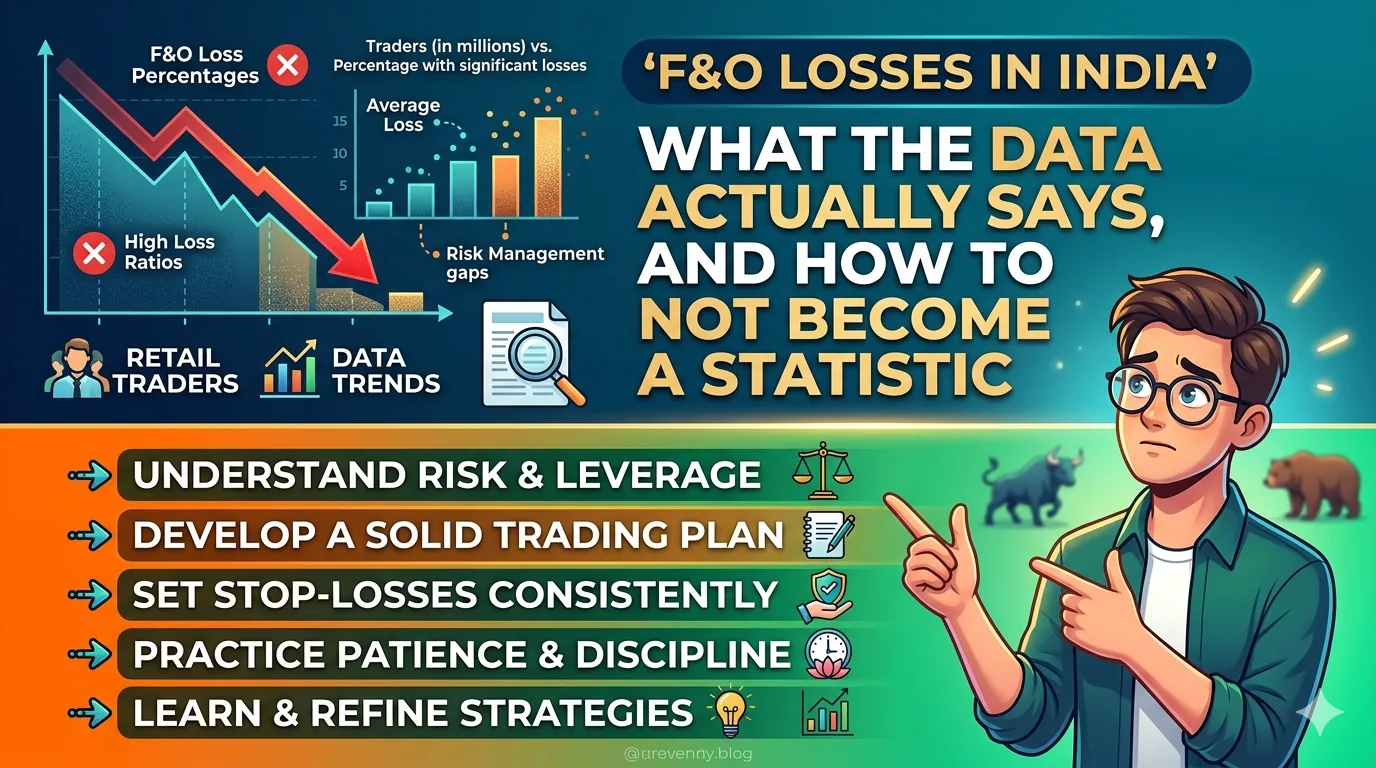
SEBI's own data shows 91% of F&O traders lost money in FY25, with net losses hitting ₹1.05 lakh crore. Here's what separates the few who survive — and how to avoid the trap.
There's a number that should be printed on the login screen of every trading app in India: nine out of ten. That's roughly how many individual traders in the equity derivatives segment lose money, according to the market regulator's own research. Not a coaching academy trying to sell you a course. Not a bitter ex-trader on social media. SEBI.
If you trade Futures & Options, or you're thinking about starting, this is the most important article you'll read this month. Not because it'll make you money — but because it might stop you from losing it.
The numbers, plainly
SEBI's comparative study of the equity derivatives segment found that net losses of individual traders surged 41% year-on-year, reaching ₹1,05,603 crore in FY24-25, up from ₹74,812 crore the year before. The study looked at the trading data of nearly 96 lakh individual investors. And it marked the second consecutive year in which around nine out of ten individual traders ended up in the red.
The average loss per person was roughly ₹1.1 lakh. Read that again. The average participant didn't make a little or break even — they lost over a lakh of rupees, while a small minority on the other side of those trades collected the winnings.
That last point matters. Markets are close to a zero-sum game in derivatives. When 91% of retail consistently loses, someone consistently wins — and it's largely institutional players with sophisticated algorithms, faster execution, and far deeper pockets. You are not in a fair fight, and pretending otherwise is the first mistake.
Why retail loses (it's not bad luck)
The losses aren't random. They cluster around a handful of structural problems:
No edge. Most retail traders have no defined, repeatable reason their strategy should make money over time. They react to tips, news, and gut feeling. Without an edge, you're not investing or even speculating intelligently — you're paying brokerage and taxes to gamble.
Options decay is brutal. A huge share of retail activity is in index options, especially cheap, far-out-of-the-money weekly options that feel like lottery tickets. Most expire worthless. The "small bet, huge payoff" structure is exactly what makes them so reliably destructive to the average account.
No risk management. No position sizing, no stop-loss discipline, and an account bet far too large on single trades. One bad week wipes out months of small gains.
Overtrading. The low cost and 24/7 accessibility of trading apps encourage constant activity. Every trade has a cost; every impulsive trade compounds the disadvantage.
What the regulator has done about it
SEBI didn't just publish scary numbers — it acted. Over the past couple of years the regulator has rolled out a series of measures aimed at cooling speculative excess: limiting the number of weekly index expiries, increasing contract (lot) sizes so the minimum bet is larger and more serious, tightening position limits, requiring upfront collection of option premiums, and adding higher risk coverage on expiry days. Brokers were also mandated to show prominent risk disclosures.
The early effect is visible. The number of unique individual traders in the segment fell noticeably across FY25, and SEBI noted some reduction in losses in the final quarter. The regulations are genuinely protective — even if they feel restrictive to someone itching to trade.
What the survivors actually do differently
The minority who don't blow up aren't luckier or smarter in some mystical way. They behave differently:
- They treat it as a business, not a thrill. Defined strategy, defined risk per trade, records kept, results reviewed.
- They size positions so no single trade can hurt them. Risking 1–2% of capital per trade, never the whole account on a "sure thing."
- They respect the stop-loss every time. No hoping, no averaging down on losers.
- They don't chase weekly lottery options. They understand the math is against the buyer of cheap, expiring options.
- They build genuine knowledge — of the instrument, the strategy, and the risk — instead of outsourcing their thinking to a Telegram channel.
And many of them lean on legitimate, registered research rather than anonymous tips. That doesn't guarantee profit, but it replaces noise with a disclosed, accountable methodology — which is a meaningful upgrade over reacting to whatever a stranger posts.
So should you trade F&O at all?
For most retail investors, the honest answer is: probably not, or at least not yet, and not with money you can't afford to lose. F&O is a leveraged, fast, unforgiving arena designed for participants with an edge, capital, and discipline. If you don't have all three, the data is screaming what will most likely happen.
If you're drawn to the markets — and there's nothing wrong with that — start where the odds are far kinder: long-term equity investing, where time works for you instead of against you, and where a sound research process compounds rather than decays.
Explore the Verified SEBI RA's - https://kuberhunt.com/experts
The bottom line
The 9-out-of-10 statistic isn't a challenge to beat the odds. It's a warning about what the odds actually are. The people who survive in derivatives do so by respecting risk obsessively, trading with a real edge, and never confusing activity with skill. Most importantly, they know the difference between a disciplined strategy and a hopeful gamble. If you can't tell which one you're running, the data already knows the answer.
This article is for educational and informational purposes only and does not constitute investment advice. Derivatives trading involves a high risk of loss and is not suitable for all investors. The statistics cited are from publicly reported SEBI studies. Past performance does not guarantee future results. Consult a qualified, SEBI-registered professional before trading.