
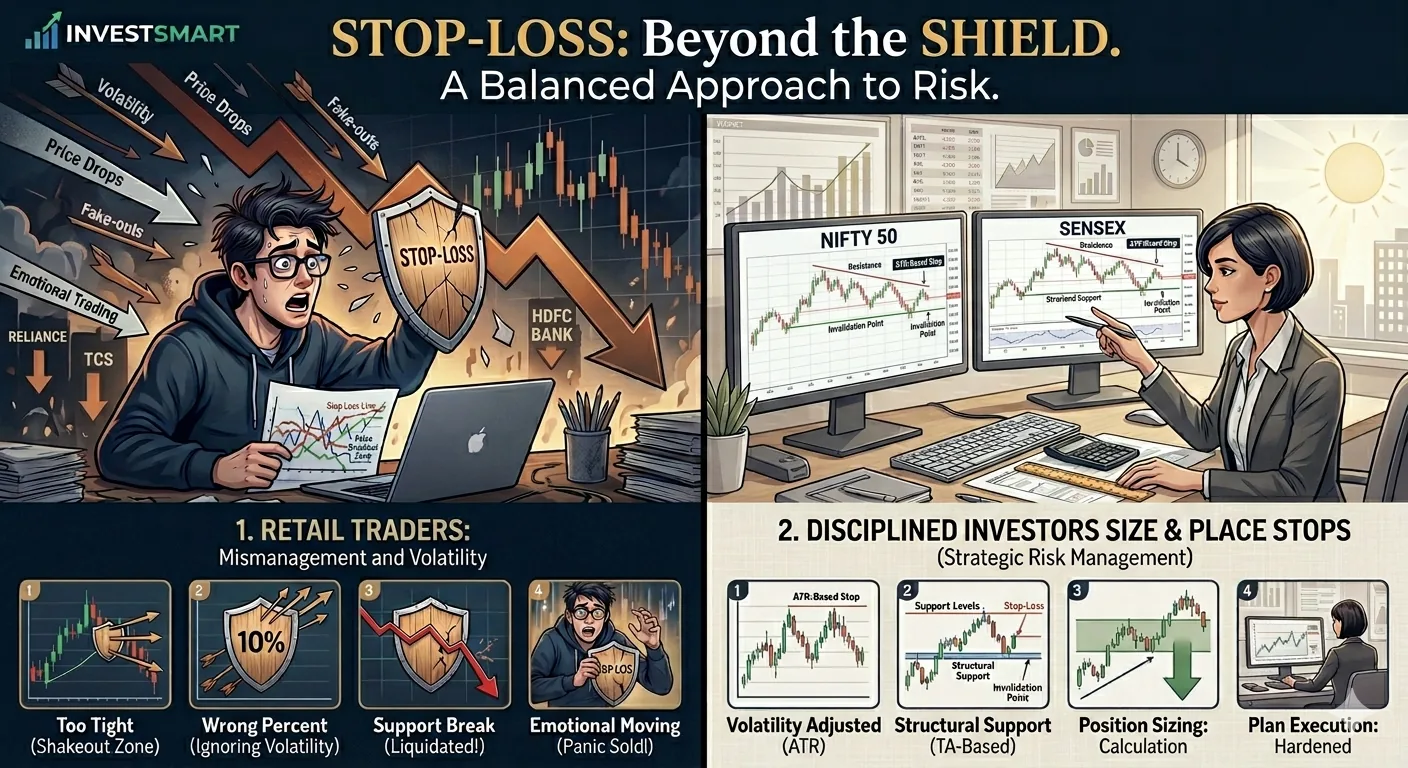
A stop-loss isn't a magic shield. Learn the four ways retail traders misuse it — and how disciplined investors actually size and place their stops.
Ask ten retail traders if they use a stop-loss and nine will say yes. Ask them how they set it, and you'll hear ten different answers, most of them wrong. The stop-loss is the most talked-about risk tool in trading and the most misunderstood. It's not the problem when traders blow up their accounts — it's the absence of a real one, or worse, one used incorrectly.
Let's fix that.
What a stop-loss actually is
A stop-loss is a pre-decided price at which you exit a trade to cap your loss. You buy a stock at ₹500, you decide that if it falls to ₹470 you're out, no arguments. That ₹470 is your stop-loss.
The point is not to be right. The point is to make sure that when you're wrong — and you will be wrong often — the damage is small and survivable. A stop-loss converts an open-ended "how much could I lose?" into a fixed, known number you accepted before emotions got involved.
That last part is the whole game. The stop-loss is a decision you make with a calm mind to protect you from the decisions you'll make with a panicked one.
The four ways traders get it wrong
Mistake 1: Setting it too tight. New traders often place their stop just a rupee or two below their entry, thinking they're being "safe." In reality they're guaranteeing they get knocked out by normal market noise. Stocks wiggle. A stop placed inside that natural wiggle room isn't risk management — it's a near-certain exit at a small loss, over and over, until your capital bleeds away through a thousand cuts.
Mistake 2: The "mental" stop-loss. "I'll sell if it drops to ₹470, I'll just watch it." No, you won't. When the stock hits ₹470, your brain will invent reasons to wait. It'll bounce. The market's just having a bad day. I'll give it one more rupee. A mental stop is not a stop. It's a hope. The only stop that works is one you've actually placed or committed to mechanically.
Mistake 3: Moving the stop the wrong way. It's fine to raise a stop on a winning trade to lock in profit. It is never fine to lower it on a losing trade because you can't bear to take the loss. The moment you move a stop further away to avoid being stopped out, you've abandoned the plan and turned a small, controlled loss into an unlimited one.
Mistake 4: Setting the stop before sizing the position. This is the subtle one. Most people pick how many shares to buy first, then slap on a stop. Professionals do it backwards: they decide how much they're willing to lose in rupees, then let that — combined with the stop distance — determine the position size.
How disciplined traders actually do it
The right sequence is built around one question: how much am I willing to lose on this trade?
Suppose you have ₹2,00,000 and you decide no single trade should risk more than 1% of your capital — that's ₹2,000. Now you look at the chart and decide a logical stop sits ₹20 below your entry. The math then tells you your position size: ₹2,000 risk ÷ ₹20 per share = 100 shares. Not "however many I can afford" — exactly 100, because that's the number that keeps your loss capped at ₹2,000 if the stop triggers.
This flips the entire psychology. The stop is no longer an afterthought; it's the foundation the trade is built on. And the stop level itself should be based on the structure of the chart — below a recent support level, or beyond the stock's normal volatility — not on a random round number or how much you personally feel like losing.
There are a few common approaches to placing the level: a fixed-percentage stop (exit if down a set percent), a volatility-based stop (placed beyond the stock's typical daily range so noise doesn't trigger it), and a trailing stop (which moves up as the trade profits, locking in gains while letting winners run). Each has its place; what they share is that the level is decided in advance and respected without negotiation.
Why this connects to who you take advice from
Here's the link most tip-sellers don't want you to see. A genuine, SEBI-registered research recommendation always includes a stop-loss alongside the entry and target. That's not a formality — it's the difference between a plan and a gamble. A "tip" that names a stock to buy but never tells you where to get out is handing you unlimited downside and calling it advice.
When you evaluate any source of recommendations, the presence of a clear, justified stop-loss on every call is one of the fastest ways to tell professionals from punters.
Explore the verified SEBI RA's - https://kuberhunt.com/experts
The bottom line
A stop-loss won't make you profitable on its own. But trading without one — or with one you don't respect — is how accounts die. Size your position around your risk, place your stop based on the chart and not your feelings, never widen it to avoid a loss, and treat it as a commitment rather than a suggestion. Do that consistently and you've already done more for your survival as a trader than most people in the market.
This article is for educational and informational purposes only and does not constitute investment advice. Trading and investing in securities involve substantial risk of loss. Past performance does not guarantee future results. Consult a qualified, SEBI-registered professional before making trading decisions.