
Final Thoughts: 90 Seconds vs. 90 Days of Regret
Introduction: Why 90 Seconds Could Save You Lakhs
Every day, thousands of Indian investors join WhatsApp groups, Telegram channels, and "advisory" apps promising guaranteed stock tips. A worrying number of these "experts" have one thing in common — they aren't registered with SEBI. And by the time investors realise it, the money is already gone.
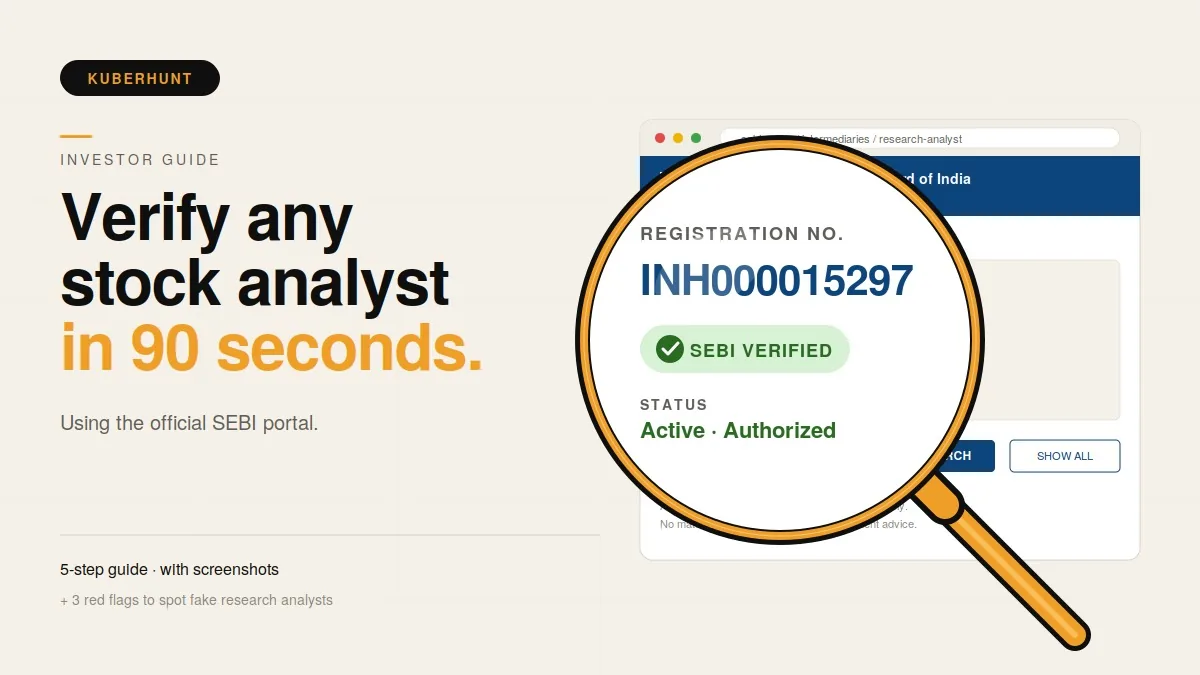
Here's the good news: verifying whether a Research Analyst (RA) is genuinely registered with the Securities and Exchange Board of India (SEBI) takes less than 90 seconds. You don't need a CA, a lawyer, or any prior knowledge of the market. You just need the right link, the right number, and the right checks.
This guide walks you through the exact process — fast, free, and foolproof.
What Is a SEBI Registered Research Analyst (RA)?
A SEBI Registered Research Analyst is a professional or firm authorised under the SEBI (Research Analysts) Regulations, 2014 to publish research reports and issue buy, sell, or hold recommendations on stocks, F&O, ETFs, and other securities.
Every registered RA gets a unique INH-prefixed registration number (for example, INH000017550). This number is your single source of truth. If someone claims to be a SEBI RA but cannot share this number — or shares one that doesn't check out — walk away.
Key distinction: A Research Analyst (RA) publishes general research. An Investment Advisor (RIA) gives personalised, portfolio-level advice. Both must be SEBI-registered, but their licences are different. RAs carry an INH number; RIAs carry an INA number.
Why Verification Is Non-Negotiable in 2026
The Indian retail investor base has crossed 19 crore demat accounts, and with it, the number of unregistered "tipsters" has exploded. SEBI itself has issued multiple investor alerts in 2025–2026 about fake advisory groups operating under the guise of registration.
Working with an unregistered RA exposes you to:
- Pump-and-dump schemes where you're the exit liquidity
- Profit-sharing scams (which SEBI strictly prohibits for RAs)
- Fake performance screenshots and doctored P&L statements
- No legal recourse — unregistered entities cannot be complained against on SCORES
- Guaranteed-return promises, which no legitimate analyst can ever make
Verification is your first and cheapest layer of defence.
How to Verify a SEBI RA in Under 90 Seconds: Step-by-Step
Here's the exact workflow. Set a 90-second timer if you want — it's faster than ordering chai.
Step 1: Get the Registration Number (10 seconds)
Ask the analyst directly: "What is your SEBI Research Analyst registration number?"
A genuine RA will share it instantly — usually it's already on their website footer, app, email signature, and research reports. The number must:
- Start with INH
- Be followed by 9 digits
- Look like: INH000017550 or INH200009193
If they hesitate, send a "certificate image", or share only screenshots — that's already a red flag.
Step 2: Open the Official SEBI Portal (15 seconds)
Go to the official SEBI website: https://www.sebi.gov.in
Navigate to: Intermediaries → Recognised Intermediaries → Research Analyst
Or directly visit the Research Analyst directory page on sebi.gov.in.
⚠️ Warning: Never use third-party "verification" websites. Many fake portals exist that show forged "verified" results. SEBI's own website is the only legitimate source.
Step 3: Search by Name or Registration Number (20 seconds)
The SEBI portal lets you search by:
- Entity name (e.g., the firm or individual's name)
- INH registration number
- PAN or address (in some views)
Enter the INH number provided. If it's genuine, a record will appear immediately.
Step 4: Cross-Verify the Four Critical Fields (30 seconds)
This is where most investors stop too early. Don't. Check these four things:
| Field | What to Confirm |
|---|---|
| Name | Matches exactly what the analyst told you (no spelling tweaks) |
| Registration Status | Must show "Active" or "Perpetual" — not Expired, Suspended, or Cancelled |
| Validity Date | Registration is current and not lapsed |
| Address / Principal Analyst | Matches the contact details on their website/app |
Even a single mismatch — say, the registration belongs to a different firm than the one pitching you — means the number is being misused.
Step 5: Bonus Check on SCORES (15 seconds)
SEBI's SCORES (SEBI Complaints Redress System) portal — scores.sebi.gov.in — lets you check whether the RA has unresolved complaints filed against them. A registered RA must resolve complaints within 30 days; repeated failures are a clear signal of poor conduct.
Total time: ~90 seconds. Cost: ₹0.
Red Flags That Should End the Conversation Instantly
Even when an INH number checks out, watch for behavioural red flags that often indicate a misused or borrowed registration:
- "Guaranteed returns" or "100% accuracy" claims — illegal under SEBI regulations
- Profit-sharing models — strictly prohibited for RAs
- Requests for trading account access or login credentials — never legal
- Pressure to deposit money into "advisor accounts" — registered RAs never handle client funds
- WhatsApp/Telegram groups with names like "SEBI Advisory Group" — SEBI does not run advisory groups
- Screenshots of "SEBI certificates" instead of a verifiable INH number
- Asking for payment in personal UPI IDs or crypto wallets
Common Scam Patterns in 2025–2026
Based on recent SEBI alerts and reported cases, here are the most frequent verification-evading tricks:
1. The "One Digit Off" Trick Scammers create INH-format numbers that look real but don't exist. For example, if INH000017550 is genuine, a fraud might use INH000017551. The fix: always verify on the portal — don't just eyeball the format.
2. The Expired Registration Resale Some operators recycle INH numbers belonging to analysts whose registrations have expired or been cancelled. The number "exists" historically but isn't active. Always check the validity status and date — not just whether the number returns a result.
3. The Borrowed Credential A small-time tipster shows a screenshot of a legitimate research firm's certificate and claims affiliation. Cross-check the name and address fields on the SEBI portal against who is actually contacting you. If they don't match, the credential is borrowed or stolen.
4. The Fake Verification Site Search results sometimes surface fake "SEBI verification" portals that confirm whatever number you type in. Bookmark sebi.gov.in and use only the official domain.
What a Genuine SEBI RA Will Always Do
Legitimate Research Analysts operate under strict disclosure norms. Expect them to:
- Display the INH number on their website footer, app, and every research report
- Provide research with clear entry, target, and stop-loss levels (for trade calls)
- Disclose conflicts of interest in every report
- Offer the same research to all subscribers — not "personal" calls based on your portfolio
- Never promise guaranteed returns
- Issue a standard risk disclaimer with every recommendation
Frequently Asked Questions (FAQs)
How do I know if a SEBI RA registration is still valid?
Check the Registration Status field on the SEBI portal. It should read "Active" or "Perpetual". "Expired", "Suspended", or "Cancelled" means the RA cannot legally operate today.
Can I verify a SEBI RA on a third-party website?
You shouldn't. While many websites display SEBI data, the only authoritative source is sebi.gov.in. Fake verification portals do exist and have been used to legitimise scams.
What's the difference between an INH and INA number?
INH is for Research Analysts (research and trade recommendations). INA is for Investment Advisors (personalised financial advice and portfolio planning). They are governed by different SEBI regulations.
Can a SEBI RA guarantee profits or share profits with me?
No. SEBI strictly prohibits Research Analysts from promising returns or operating on profit-sharing models. If anyone offers this, they are violating SEBI regulations — registered or not.
What should I do if I've already paid an unregistered analyst?
File a complaint on SCORES (scores.sebi.gov.in) and also report to your local cybercrime cell at cybercrime.gov.in. The earlier you act, the higher your chances of recovery.
Are RAs allowed to manage my trading account directly?
Absolutely not. A Research Analyst publishes research — they do not place trades on your behalf or hold your funds. Anyone asking for your trading account login or money transfer is operating illegally.
Final Thoughts: 90 Seconds vs. 90 Days of Regret
The Indian stock market rewards discipline, but it punishes shortcuts ruthlessly. The single most valuable habit you can build as an investor isn't picking the right stock — it's filtering out the wrong people from your information diet.
A 90-second check on sebi.gov.in before you subscribe, pay, or place a trade based on someone's advice is the cheapest insurance policy you'll ever buy. Make it routine. Make it non-negotiable.
If the INH number checks out on the official portal, with active status and matching details — you've cleared the first gate. If anything is off, you've just saved yourself from a potentially expensive mistake.
Verify first. Trust later. Invest wisely.
Disclaimer: This blog is for educational and informational purposes only and does not constitute investment advice. Investments in securities markets are subject to market risks. Read all scheme-related documents carefully before investing.