
On May 12, 2026, the Nifty IT index crashed nearly 4% in a single session, dragging TCS, Infosys, Wipro, HCL Tech, and Tech Mahindra to fresh 52-week lows. The trigger was OpenAI's $4 billion expansio
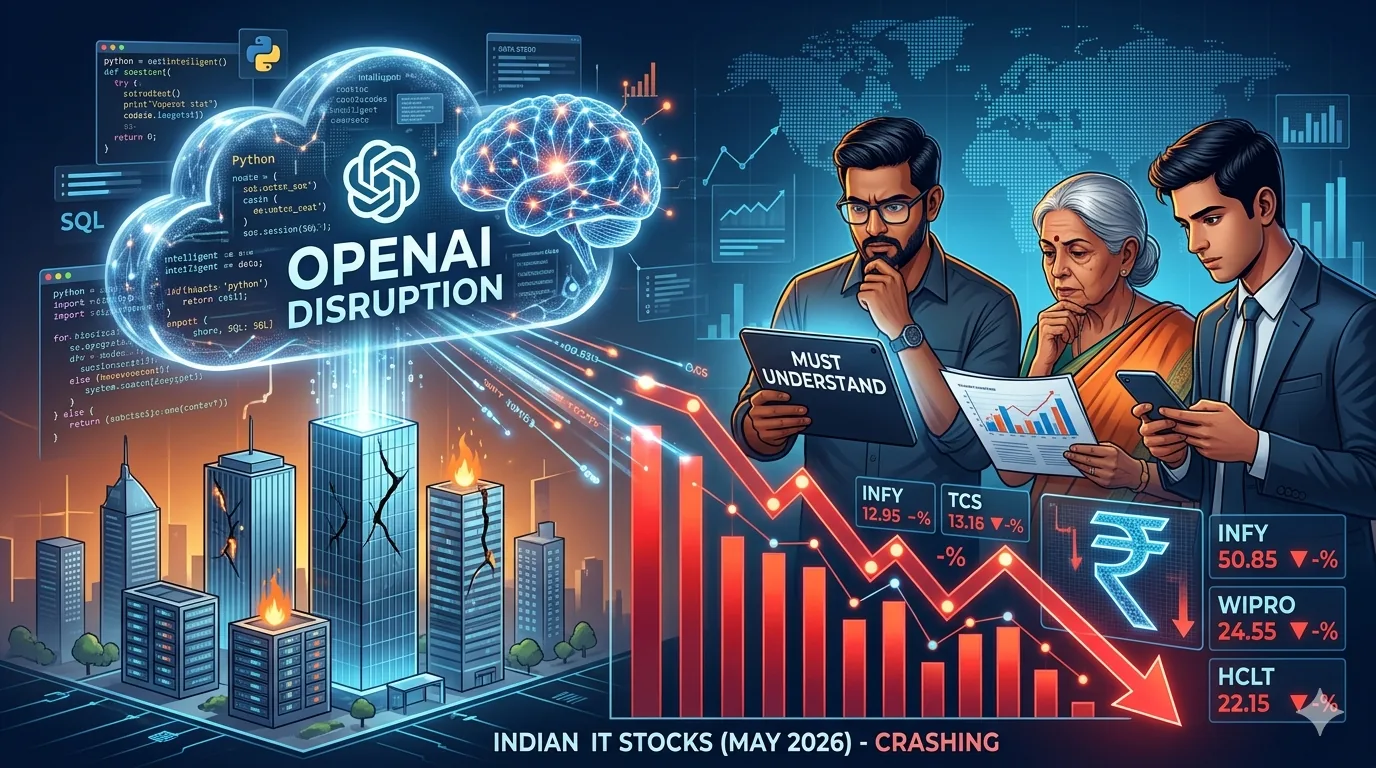
On May 12, 2026, the Nifty IT index crashed nearly 4% in a single session, dragging TCS, Infosys, Wipro, HCL Tech, and Tech Mahindra to fresh 52-week lows. The trigger was OpenAI's $4 billion expansion into AI-led tech services — a direct challenge to India's $250+ billion IT services industry. If you own IT stocks in your portfolio or SIP, here's exactly what's happening, why it matters, and how to think about it without panicking.
What Just Happened
For most of the last two decades, Indian IT giants — TCS, Infosys, Wipro, HCL Tech, and Tech Mahindra — were the defensive darlings of every retail portfolio. Strong dollar earnings, consistent dividends, predictable growth.
That story cracked open this week.
On May 12, 2026, the Nifty IT index dropped roughly 4% in one session. TCS and Infosys both hit fresh 52-week lows. The broader Sensex shed over 770 points, and IT alone accounted for the bulk of the damage. Combined with crude oil spikes from renewed Middle East tensions and continued FII selling (foreign investors pulled out ₹4,111 crore on a single Friday earlier in the month), it has been one of the ugliest weeks for Indian markets in 2026.
The reason is not just macro — it is structural. And it is called OpenAI.
The OpenAI Trigger Explained Simply
OpenAI — the company behind ChatGPT — announced a $4 billion deployment venture to deliver AI-led technology services directly to enterprises worldwide. In plain English: the kind of work an enterprise used to hire TCS, Infosys, or Accenture for — building software, integrating systems, managing IT operations — OpenAI now wants to do with AI agents, at a fraction of the cost and time.
This is a problem for Indian IT for three reasons:
1. The "people-hour" model is the threat
Indian IT's classic business model is straightforward: assign 100 engineers to a project, bill the client per hour or per engineer per month. If an AI agent can do the work of 30 of those engineers, the contract value collapses overnight.
2. Existing contracts are getting renegotiated
Large clients (banks, retailers, healthcare firms in the US and Europe) are walking into renewal meetings and asking the same question: "Why am I paying you for 100 people when AI can do half of this?" Margins compress before headcount even falls.
3. New deals are getting smaller
Multi-year, multi-billion-dollar transformation deals are being broken into smaller, AI-augmented engagements. The IT order book — long the pride of TCS and Infosys quarterly results — is no longer the moat it used to be.
This is what the market is pricing in. Not a single bad quarter, but a possible multi-year shift in how enterprise IT spending flows.
---------------------------------------------------------------------
What the Numbers Are Telling You
A few data points from this week worth understanding:
- Nifty IT: down ~4% on May 12 alone; hit a 52-week low.
- TCS and Infosys: fresh 52-week lows.
- Sensex: closed at 75,236.83 on May 12 — about 4.9% above its 52-week low.
- Technical signal: Sensex is trading below both its 50-day and 200-day moving averages, with a bearish crossover — a classic technical sign of weak trend.
- Market breadth: of 38 sectors tracked, only 11 advanced, 27 declined. This is not an IT-only story; it is broad-based caution.
The IT story is the loudest, but the backdrop is general nervousness — high crude, weak rupee, FII selling, and now the AI overhang.
--------------------------------------------------
What This Means for Different Types of Retail Investors
If you have direct stock holdings in IT
This is the moment to revisit your thesis, not panic-sell. Ask yourself:
- Did I buy this for dividend income? The dividend is probably safe in the short term, but capital appreciation may be muted for a while.
- Did I buy this for growth? The growth assumption needs a hard re-examination in the AI era.
- Am I overweight IT (say, more than 15-20% of my equity)? Concentrated bets in a structurally challenged sector are risky.
Selling into a 52-week low is almost always emotional, not analytical. But adding more capital to IT here without a clear, updated thesis is also risky.
If you have IT exposure through mutual funds
You probably have less to worry about than you think. Most diversified equity funds keep IT at 10-15% of the portfolio. Even a sharp IT correction translates to a 1-2% drag at the fund level, which is usually offset by other sectors.
Open your fund factsheet, check the sector allocation, and compare it to the benchmark. If your fund is meaningfully overweight IT versus its benchmark, that's a question to ask your advisor.
If you have a thematic IT fund or IT ETF
This is more concentrated risk. Thematic funds in any sector behave like single-stock bets — they go up faster in good times and fall harder in bad ones. Ask yourself whether you still believe in the structural India IT story, or whether you bought based on recent past returns.
If you're a SIP investor
SIPs were literally designed for moments like this. You buy more units when prices fall and fewer when they rise — that is rupee-cost averaging at work. Don't pause your SIPs in a correction. That is the single biggest mistake retail investors make, and decades of data shows it destroys long-term returns.
-----------------------------------------------------------------
Is This 2000 Dot-Com 2.0 for Indian IT?
The short, honest answer: it is too early to tell, but the disruption is real.
Some context:-
- Indian IT has navigated multiple disruptions before — Y2K, the 2008 financial crisis, the cloud transition, and COVID. Each time, the sector adapted and emerged stronger.
- These companies are not standing still. TCS, Infosys, and others have already launched their own AI platforms (TCS' BaNCS AI, Infosys Topaz, Wipro ai360). The question is whether they can transition fast enough.
- AI itself creates demand for IT services — integration, fine-tuning, data engineering, governance. The pie may shift, but it isn't shrinking to zero.
But the margin profile of the industry is likely to compress. Investors who were paying 25-30x earnings for "stable growth" may not be willing to pay that multiple for "AI-disrupted, transitioning" businesses. That re-rating is what is playing out in real time.
---------------------------------------
What Smart Retail Investors Are Doing Right Now
A few practical, non-speculative moves:
1. Review portfolio allocation. Make sure no single sector — IT, banking, consumer, anything — is more than 25-30% of your equity. Diversification is the single best free protection against shocks like this.
2. Don't try to "catch the bottom." Calling a bottom in a falling stock is one of the hardest things in investing. If you must add to IT, stagger it across 4-6 tranches over 3-6 months.
3. Focus on quality within the sector. If you still want IT exposure, the companies with stronger AI products, larger cash piles, and better margin profiles will likely survive and adapt better.
4. Watch the Q1 FY27 earnings (July 2026). This will be the first full quarter where AI-related deal pressure shows up in numbers. Order book guidance, attrition, and headcount commentary will tell you whether the panic is justified or overdone.
5. Don't take advice from random Telegram groups. This is exactly the kind of moment when unregulated "tip providers" promise to call the bottom. SEBI's recent crackdown on unregistered advisers exists because such "tips" cost retail investors crores every year. Stick to SEBI-registered Research Analysts whose track record is verifiable.
-------------------------------------------------------------
The Bigger Picture: India's Market Is Maturing
The May 2026 IT correction, however painful, is a sign of a maturing market. Investors are no longer rewarding all listed companies equally. Sectors with weak structural stories are being repriced. Sectors with genuine tailwinds (PSU banks, defence, capital goods, oil & gas this week) are getting flows.
For long-term retail investors, this is actually healthier than the broad-based rally of 2023-24, where many low-quality stocks went up simply because the market was rising. A market that distinguishes between winners and losers is one where research-driven investing finally pays off.
------------------------------------------------------------
## Key Takeaways
- The Nifty IT crash on May 12, 2026 was triggered primarily by OpenAI's expansion into AI-led tech services, threatening Indian IT's traditional people-hour model.
- TCS and Infosys at 52-week lows is a structural warning, not just a bad day.
- For mutual fund and SIP investors, the impact is manageable — don't pause your SIPs.
- For direct IT stockholders, this is a time to revisit your thesis, not panic.
- Diversification, quality focus, and waiting for Q1 FY27 numbers are the smart plays.
---------------------------------------------------------------------------
Markets reward patience and process, not panic and prediction. The May 2026 IT crash is a textbook reminder that even the bluest of blue-chip stories can face structural disruption. The retail investors who emerge from this stronger will be the ones who stayed diversified, kept SIPs running, and relied on registered advisers instead of WhatsApp tips.
If you are a SEBI-registered Research Analyst helping clients navigate moments like this, Kuberhunt.com offers the compliance and client-management backbone you need to focus on the research, not the paperwork. [Learn more from experts - Kuber Experts]
---------------------------------------------------------------------------------------
*Disclaimer: This article is for educational purposes only and does not constitute investment advice. Stock prices and indices mentioned are accurate as of May 12, 2026 based on publicly reported data. Please consult a SEBI-registered Research Analyst or Investment Adviser before making investment decisions.*