
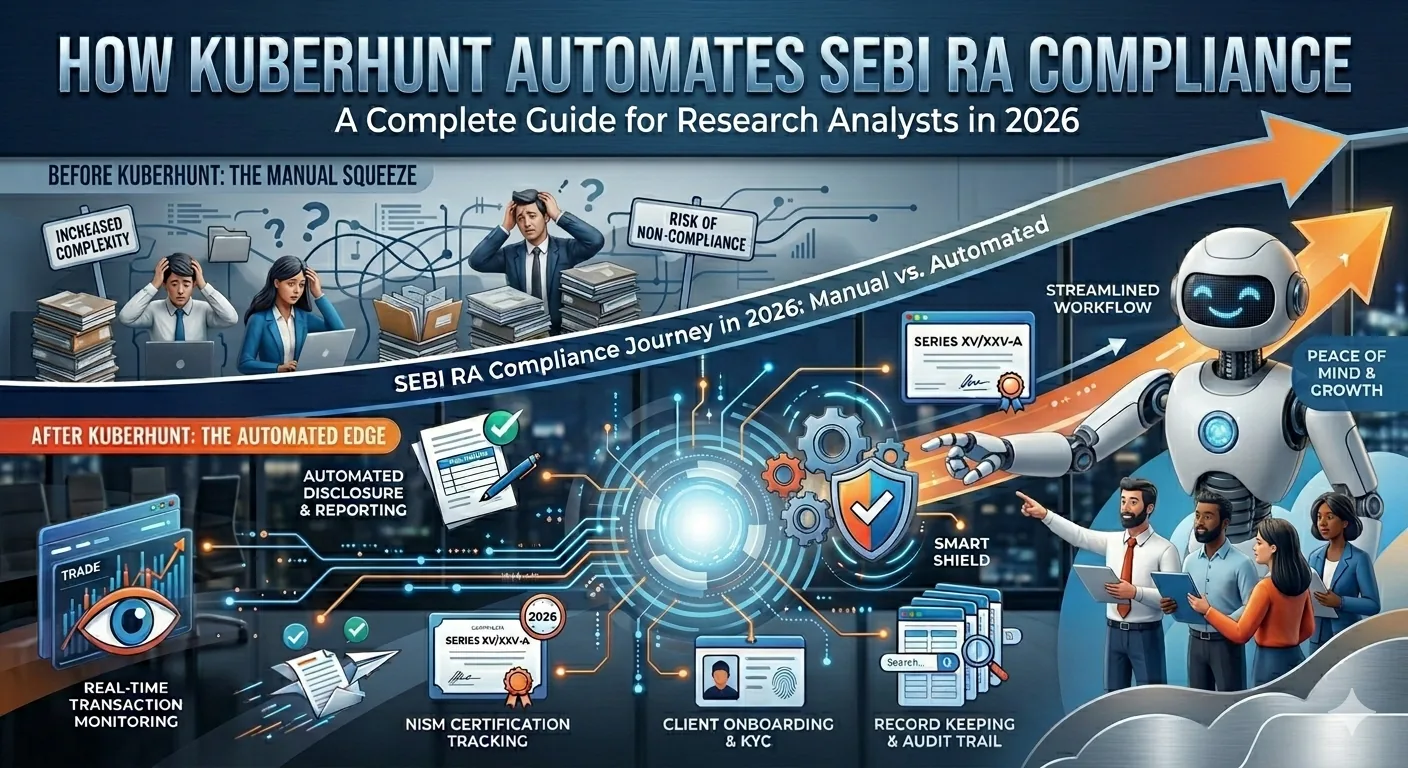
Discover how Kuberhunt.com automates end-to-end SEBI Research Analyst (RA) compliance
How Kuberhunt Automates SEBI RA Compliance: A Complete Guide for Research Analysts in 2026
SEBI's Research Analyst (RA) regulations now demand auditable, end-to-end compliance — from KRA-based KYC validation and a signed MITC, to verifiable payments, controlled Telegram access, and detailed client and trade records. Kuberhunt.com is built ground-up to automate every one of these obligations on a single platform, so independent RAs and advisory firms can spend more time on research and less on paperwork. This guide walks through all ten compliance pillars Kuberhunt automates, including the upcoming PaRRVA integration.
Why RA Compliance Has Become a Full-Time Job
If you are a SEBI-registered Research Analyst in India, you already know the regulatory bar has climbed sharply. The SEBI (Research Analysts) Regulations, 2014 — together with the latest 2024–2025 amendments and circulars — now require RAs to:
- KYC every client through a SEBI-registered KRA (KYC Registration Agency).
- Sign a Most Important Terms and Conditions (MITC) document with each client before service delivery.
- Collect payments through traceable, regulator-friendly channels.
- Maintain proof of every recommendation, every communication, and every subscription change.
- Honour grievance redressal, advertisement codes, and the upcoming PaRRVA (Past Risk and Return Verification Agency) framework.
For a solo RA or a small team, doing this manually across spreadsheets, WhatsApp, Telegram, email, and a payment gateway is a recipe for missed audits and SEBI inspections. Kuberhunt automates the entire workflow in one compliance-first stack.
Below is a deep dive into the ten capabilities that make Kuberhunt the operating system for Research Analyst compliance in India.
1. KRA Validation Automation (KYC for Research Analysts)
What SEBI requires
Every client onboarded by a Research Analyst must have valid KYC records with a SEBI-registered KRA — CVL KRA, NDML, CAMS KRA, Karvy, or NSE KRA. The RA must verify status before initiating any paid advisory relationship.
What Kuberhunt does
Kuberhunt's KRA Validation Automation module performs real-time KYC lookups against KRA APIs the moment a prospect enters their PAN. The system automatically:
- Pulls KRA status (Validated / Registered / On-Hold / Rejected).
- Cross-checks name, DOB, and address against the PAN record.
- Flags clients whose KYC is incomplete and triggers a re-KYC workflow.
- Stores the API response with a timestamp, creating an immutable audit log SEBI inspectors can verify.
Why it matters
No more manual KRA portal logins. No more screenshots in folders. Onboarding moves from days to minutes, and you have a defensible compliance trail for every client.
2. MITC Automation — Digio & OTP-Based eSign on Custom Templates
What SEBI requires
SEBI mandates that every Research Analyst execute the Most Important Terms and Conditions (MITC) with each client. The MITC must be in a prescribed format, signed by both parties, and retained for the duration of the engagement plus the regulatory record-keeping period.
What Kuberhunt does
Kuberhunt offers MITC Automation with two execution modes:
- Aadhaar-based eSign via Digio — legally valid digital signature under the IT Act, 2000.
- OTP-Based Acceptance — a SEBI-friendly consented acceptance flow for clients who prefer a lightweight option.
Key features:
- Custom MITC templates — every RA can pre-fill firm name, registration number, fee structure, services, and risk profile placeholders.
- Dynamic merge fields pull client KYC data straight from the KRA validation step, eliminating re-keying errors.
- Once signed, the MITC PDF is hash-stamped, encrypted, and stored in the client's compliance vault.
- A copy is auto-emailed to the client (covered in section 9).
Why it matters
MITC failures are one of the most common findings in SEBI inspections of RAs. Kuberhunt removes the chance of using an outdated template, missing a clause, or losing a signed copy.
SEO keywords covered: MITC automation India, Digio eSign for Research Analysts, SEBI MITC template, OTP-based document signing, client agreement automation.
3. Payment Collection to the RA's Account via Razorpay
What SEBI requires
Research Analysts must collect fees only through traceable banking or payment channels, with proper invoicing, fee caps observed (where applicable), and refunds handled per the MITC. Cash is a strict no.
What Kuberhunt does
Kuberhunt integrates natively with Razorpay so fees flow directly into the RA's own bank account — Kuberhunt never holds client money. The platform:
- Generates a payment link or hosted checkout the moment a plan is selected.
- Supports UPI(with Selected banks), cards, net banking, wallets, and EMI.
- Issues a GST-compliant invoice and payment receipt automatically.
- Reconciles every transaction to the client record so renewals, partial payments, and refunds are tracked.
- Surfaces a payment dashboard with daily, monthly, and FY views for income-tax and SEBI reporting.
Why it matters
You stay in control of your funds, your clients get a familiar checkout, and your books are inspection-ready at all times.
4. Telegram Automation — Controlled, Compliant Group Access
What SEBI requires
If you deliver advice through Telegram (a very common channel for trade calls and model portfolios), you must ensure only paying, MITC-signed, KYC-validated clients are inside the group. Unauthorized members create a serious compliance risk and have triggered SEBI action in past cases.
What Kuberhunt does
Kuberhunt's Telegram Automation wires your Telegram channels and groups directly to the subscription engine:
- Upon successful payment, the client receives a unique, single-use invite link mapped to their account.
- The bot verifies the client's identity before granting access.
- Active subscribers are auto-added; expired subscribers are auto-removed (see section 8).
- Every join, message, and removal is logged for audit.
- Multiple groups can be mapped to different plans — e.g., Intraday, Positional, Options — without manual link-sharing.
Why it matters
You eliminate the leakage problem of free-floating Telegram links and ensure your distribution channel is as compliant as your onboarding flow.
5. Client Data Reports — A Single Source of Truth
What SEBI requires
RAs must maintain detailed client records: KYC data, risk profile, services availed, fees paid, communications, and the lifecycle of the advisory relationship — retained for at least five years from the end of the engagement.
What Kuberhunt does
Kuberhunt's Client Data Reports module is a structured, queryable database of every client interaction:
- 360° client profile: KYC, KRA status, MITC version signed, risk category, active plans, payment history, communication logs.
- Filterable exports (CSV, Excel, PDF) for SEBI inspections, internal audits, or CA reviews.
- Role-based access so support staff see what they need without exposing sensitive fields.
- Automatic flagging of clients with expired KYC, lapsed subscriptions, or incomplete MITC.
Why it matters
When SEBI asks "show me everything you have on client X," Kuberhunt returns the answer in seconds — not days of spreadsheet hunting.
6. Trade Data Reports (Recommendations / Recos)
What SEBI requires
Every recommendation — stock call, options trade, model portfolio change, or market view — must be timestamped and archived with rationale, target, stop loss, and disclosure of any conflict of interest. SEBI's enhanced 2024 norms also emphasise verifiable performance claims.
What Kuberhunt does
The Trade Data Reports module captures every recommendation the moment it goes out:
- Pre-trade entry with scrip, action (Buy/Sell), entry, target, stop loss, time horizon, and rationale.
- Auto-timestamp with server-side hashing — no backdating possible.
- Linkage to the channel of communication (Telegram, email, app push).
- Post-trade outcome capture: exit price, P&L, success rate.
- Filter and export by analyst, segment (equity, F&O, commodity), period, or plan.
Why it matters
This is your evidence locker. It transforms ad-hoc trade calls into a structured, audit-ready research record — and is the foundation Kuberhunt uses to feed PaRRVA (see section 10).
7. Modelfolio Reports — Verifiable Model Portfolio Performance
What SEBI requires
If you sell a "model portfolio" service, you must be able to substantiate every claim about returns, drawdowns, holding periods, and rebalances. Misleading performance claims are an immediate red flag for SEBI and a frequent grievance trigger.
What Kuberhunt does
Modelfolio Reports turn your model portfolios into a transparent, time-stamped product:
- Versioned model portfolios — every rebalance is recorded as an immutable snapshot.
- Auto-computed CAGR, XIRR, max drawdown, win-rate, and benchmark comparison (Nifty 50, Sensex, sector indices).
- Per-client performance views that account for their actual entry date.
- Exportable PDF "factsheet" for marketing — within SEBI's advertisement guidelines — that pulls verified numbers, not manually edited ones.
Why it matters
You can finally market your model portfolios with confidence, knowing every percentage on the brochure is backed by a Kuberhunt-generated, audit-ready report.
8. Community Management — Auto-Removal Based on Plan Subscription
What SEBI requires
Once a client's subscription lapses, they are no longer entitled to receive paid advice. Continuing to share calls with non-subscribers blurs the line between paid advice and "free tips," which SEBI explicitly cautions against.
What Kuberhunt does
Kuberhunt's Community Management engine watches every subscription:
- Tracks expiry dates across all plans and channels.
- Sends automated renewal reminders at T-7, T-3, and T-0.
- On expiry without renewal, auto-removes the client from mapped Telegram groups, app communities, and broadcast lists.
- Maintains a re-entry workflow — the moment they renew, access is restored without manual intervention.
- All removals and re-adds are logged.
Why it matters
The single biggest leak in RA businesses is forgetting to remove lapsed clients from Telegram. Kuberhunt closes that gap on autopilot.
9. Automated Email Dispatch — Signed Docs, Receipts & Access Links
What SEBI requires
Clients must receive a copy of their MITC, the prescribed Terms & Conditions, the Risk Disclosure document, and any payment receipts. They should also clearly know the channels through which they will receive services.
What Kuberhunt does
At the end of every onboarding, Kuberhunt automatically dispatches a single consolidated email containing:
- The signed MITC PDF (with eSign certificate metadata).
- The current Terms & Conditions.
- The Risk Disclosure document.
- The Telegram invite link (if mapped) tied to the client's account.
- The payment receipt and GST invoice from Razorpay.
Emails are sent from a verified domain (SPF, DKIM, DMARC configured) to maximise deliverability, and every dispatch is logged. Resend-on-demand is one click away.
Why it matters
The biggest source of "I never received this" complaints in inspections is gone. The compliance documentation reaches the client automatically and is provably stored.
10. PaRRVA Integration (Coming Soon)
What SEBI is introducing
PaRRVA — the Past Risk and Return Verification Agency — is SEBI's new framework to independently verify the performance claims of Research Analysts and Investment Advisers. Once live, RAs will need to submit their recommendation and model portfolio data in a structured format to a PaRRVA-empanelled verifier. Only PaRRVA-verified numbers can be advertised.
What Kuberhunt is building
Because Kuberhunt already captures every recommendation (section 6) and every model portfolio snapshot (section 7) in a structured, timestamped, immutable format, PaRRVA submission becomes a one-click export. The roadmap includes:
- Pre-formatted PaRRVA data packages directly from the trade and modelfolio tables.
- Verifier-ready APIs to push data without CSV gymnastics.
- A "PaRRVA-verified" badge that flows into your marketing pages and factsheets once verification is granted.
- Continuous sync so renewals don't require manual data exports.
Why it matters
RAs who plug into Kuberhunt today are already PaRRVA-ready. The moment the framework is live, you'll be among the first to advertise with regulator-verified performance numbers.
Bringing It All Together: The Kuberhunt Compliance Stack
# Compliance Pillar What Kuberhunt Automates 1 KRA Validation (KYC) Real-time KRA lookups, immutable audit log 2 MITC Digio eSign + OTP signing on custom templates 3 Payments Razorpay direct-to-RA, invoices, receipts 4 Telegram Plan-mapped invite links, verified joins 5 Client Data Reports 360° client records, inspection-ready exports 6 Trade Data Reports Timestamped, hashed recommendation archive 7 Modelfolio Reports Versioned portfolios with verified analytics 8 Community Management Auto-remove on subscription expiry 9 Email Dispatch Signed MITC, T&C, risk doc, link, receipt — automated 10 PaRRVA One-click submission of verified performance data
Together these ten modules cover every recurring touchpoint between an RA, a client, and the regulator — onboarding, agreement, payment, access, advice, performance, exit, and audit.
Who Kuberhunt Is Built For
- Independent SEBI-registered Research Analysts scaling beyond a handful of clients.
- Boutique advisory firms that want one platform instead of five disconnected tools.
- Sub-advisers and partners of larger firms who need their own auditable trail.
- New RAs about to onboard their first client and don't want to build compliance from scratch.
If you fall in any of those buckets, Kuberhunt is engineered to be your default compliance backbone from day one.
Frequently Asked Questions (FAQ)
Is Kuberhunt SEBI-approved?
SEBI does not "approve" software vendors. Kuberhunt is built to help SEBI-registered RAs comply with the (Research Analysts) Regulations, 2014, related circulars, and the upcoming PaRRVA framework. The compliance obligation always remains with the registered RA — Kuberhunt is the toolset that makes meeting it practical.
Does Kuberhunt hold client funds?
No. Razorpay routes payments directly to the RA's own bank account. Kuberhunt only records the transaction for invoicing, reconciliation, and audit.
What if my MITC template is unique to my firm?
Kuberhunt supports fully custom MITC templates. You can upload your firm's version, define merge fields, and lock the clauses SEBI requires.
Can I use Kuberhunt only for Telegram automation?
Yes, modules are available individually, though the real power emerges when KYC, MITC, Payments, and Telegram are wired together — that's when one client click triggers a full compliance cycle.
When will PaRRVA go live in Kuberhunt?
The PaRRVA module is in active development and will be rolled out in line with the regulator's go-live timelines. RAs already using the Trade Data and Modelfolio modules will inherit PaRRVA-ready data automatically.
Start Automating RA Compliance Today
Compliance is no longer a once-a-year scramble before an inspection — it is a continuous, evidence-generating process. Kuberhunt.com gives Research Analysts the rails to run that process without hiring a compliance team.
👉 Visit Kuberhunt.com to book a demo and see how every one of the ten modules above can be live in your practice this week.
Disclaimer: This article is for informational purposes only and does not constitute legal or compliance advice. Research Analysts should refer to the SEBI (Research Analysts) Regulations, 2014, the latest SEBI circulars, and consult a qualified compliance professional for their specific obligations.