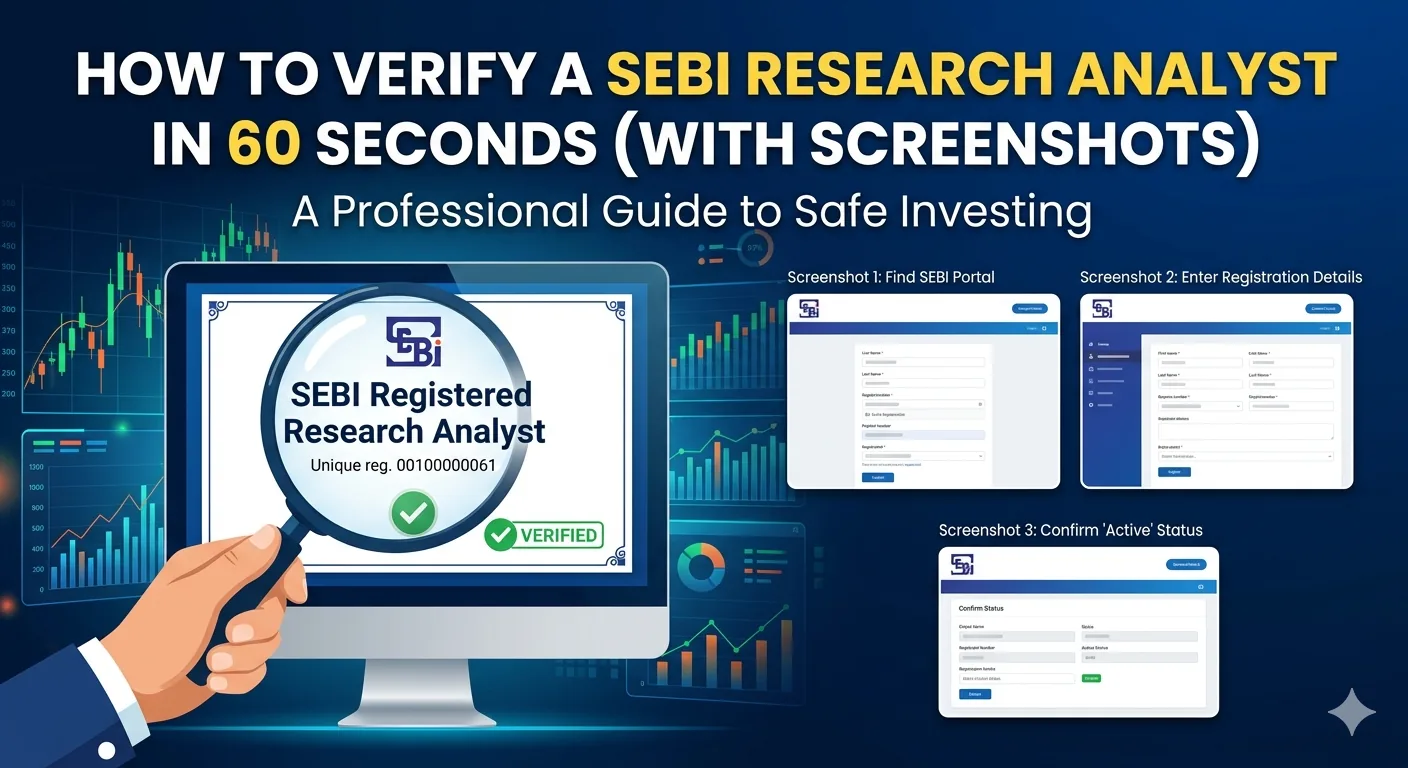
Most people who lose money to fake stock advisors didn't lose because the advisor was clever. They lost because nobody ever taught them the one-minute habit that would have prevented the whole thing.
Most people who lose money to fake stock advisors didn't lose because the advisor was clever. They lost because nobody ever taught them the one-minute habit that would have prevented the whole thing.
Verifying whether a Research Analyst is genuinely SEBI-registered takes about as long as ordering a chai. There's no app to download, no fee to pay, no form to fill. The information sits on SEBI's own website, free for anyone to check.
Here's exactly how to do it — and what to look for so you don't get fooled by a fake registration number flashed on a slick Telegram channel.
First, understand what you're looking for
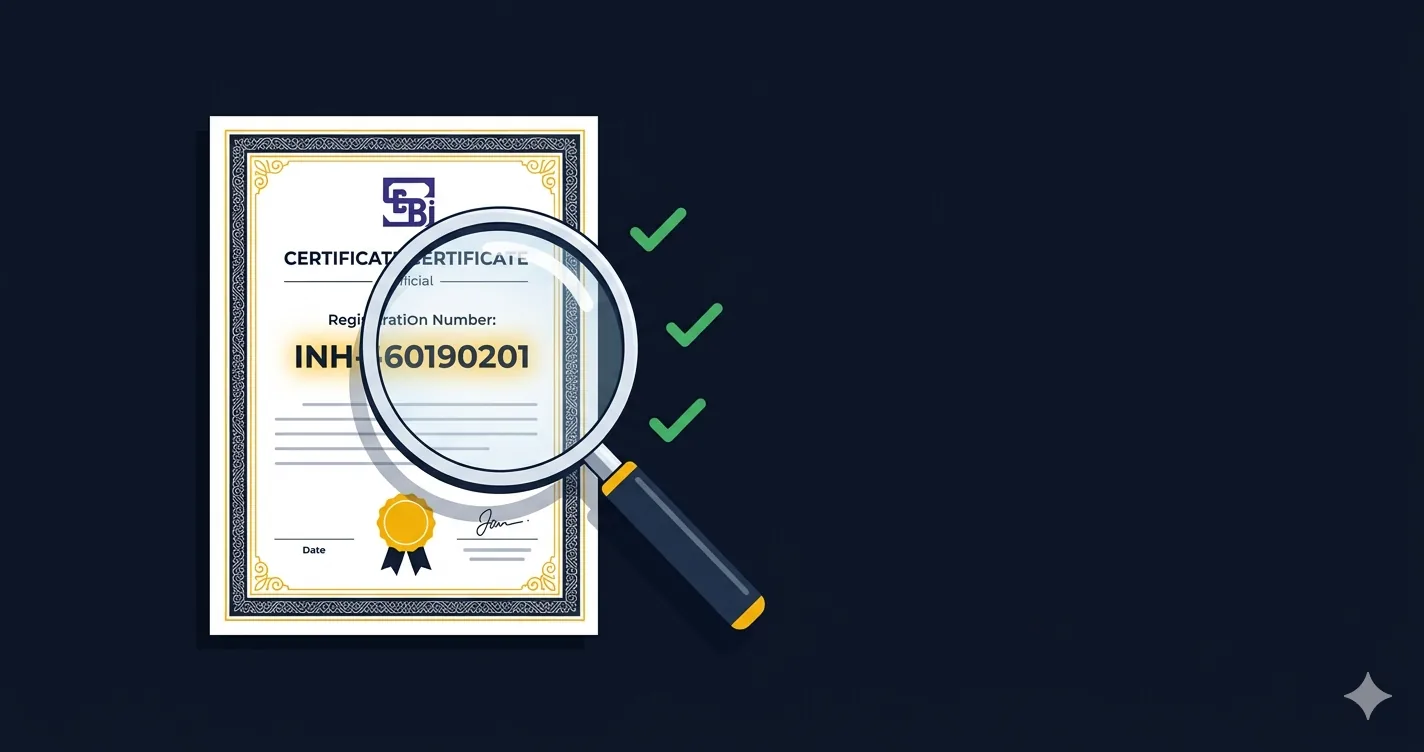
Every SEBI-registered Research Analyst is assigned a unique registration number. The format is non-negotiable and it's the single most reliable thing to check.
Research Analyst registration numbers always start with INH. Investment Advisors start with INA. Portfolio Managers start with INP. If someone selling you stock recommendations is showing you any other prefix — or no prefix at all — you're already looking at a problem.
The full format looks like this: INH000010441. Five letters and digits, padded to nine characters after the prefix. Memorise the shape. You'll spot fakes instantly once you do.
The 60-second verification process
Step 1: Find the registration number
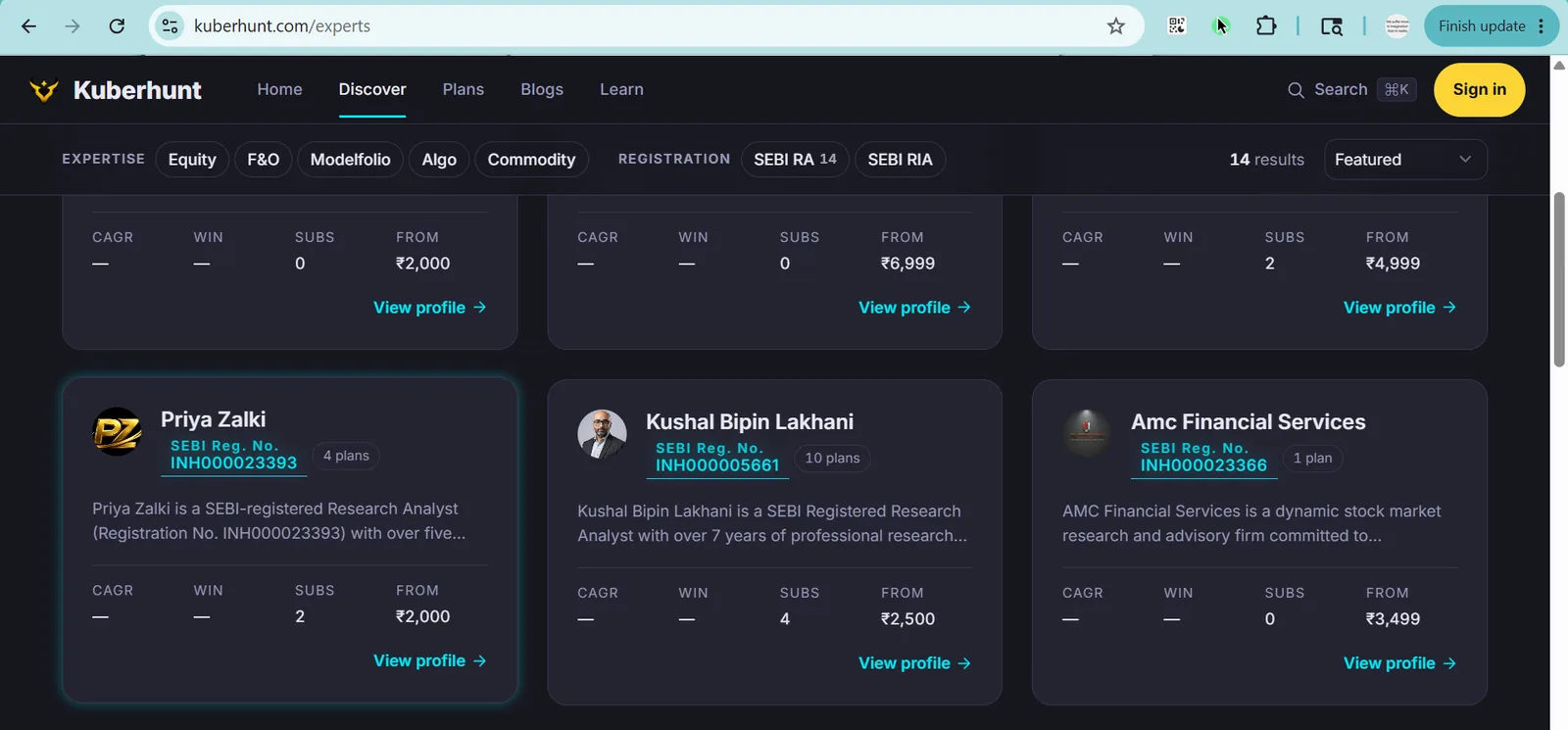
A genuine RA will display this prominently — on their website footer, social media bios, subscription pages, and at the bottom of every email or research report. If you have to hunt for it, that's already a small red flag.
On a marketplace like Kuberhunt, you'll see the registration number on every Expert profile page. On a random Telegram channel, you might see it pinned in the description, buried in a screenshot, or — quite often — not present at all.
Step 2: Open SEBI's official intermediaries page
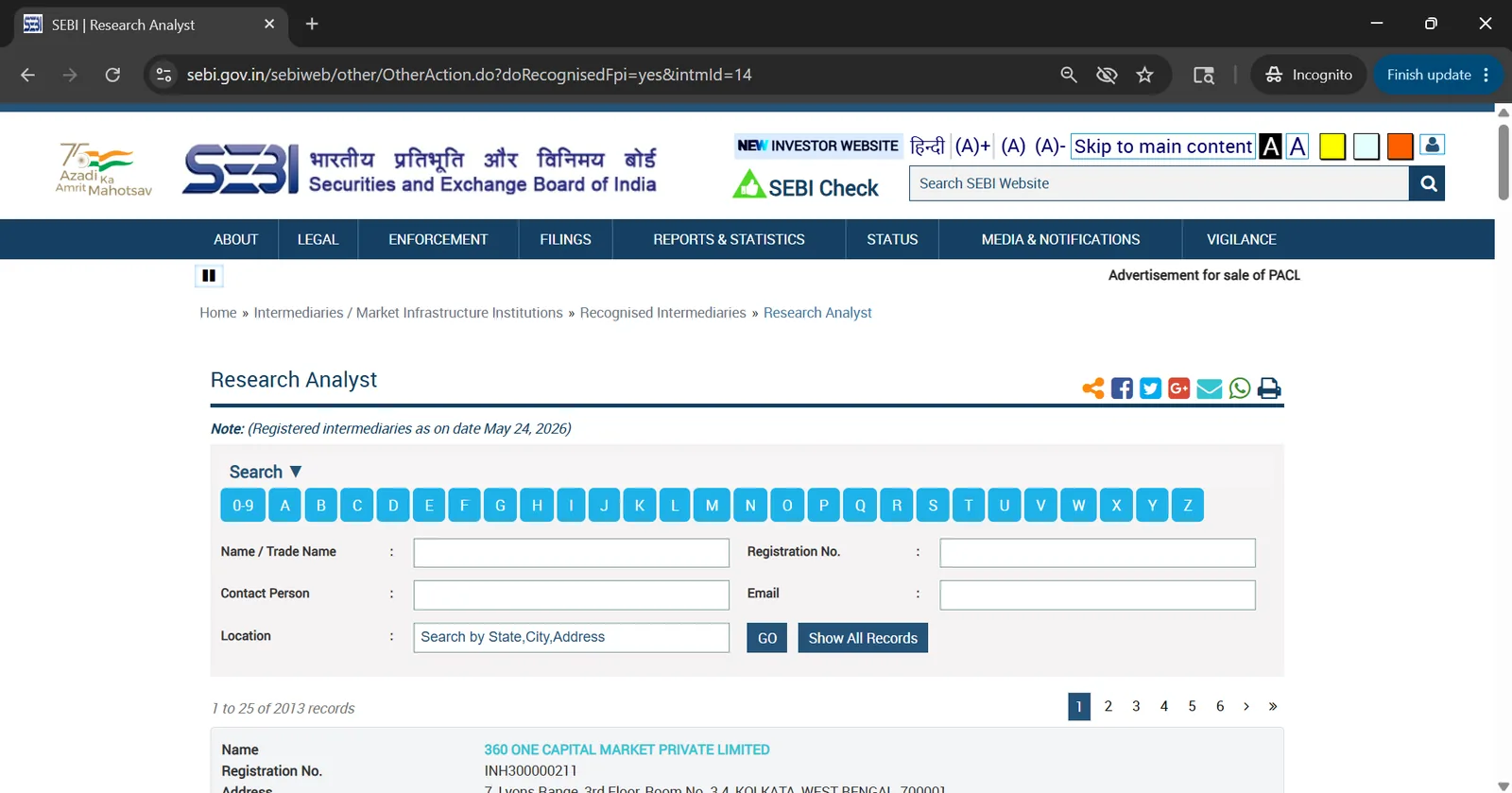
Go to sebi.gov.in. From the homepage, navigate to: Intermediaries → Recognised Intermediaries → Research Analysts. (Bookmark this; you'll come back.)
This is SEBI's live registry. It's updated regularly and is the only official source of truth. Anything else — third-party 'verification' services, broker testimonials, awards from unknown industry bodies — doesn't substitute for this.
Step 3: Search the registration number
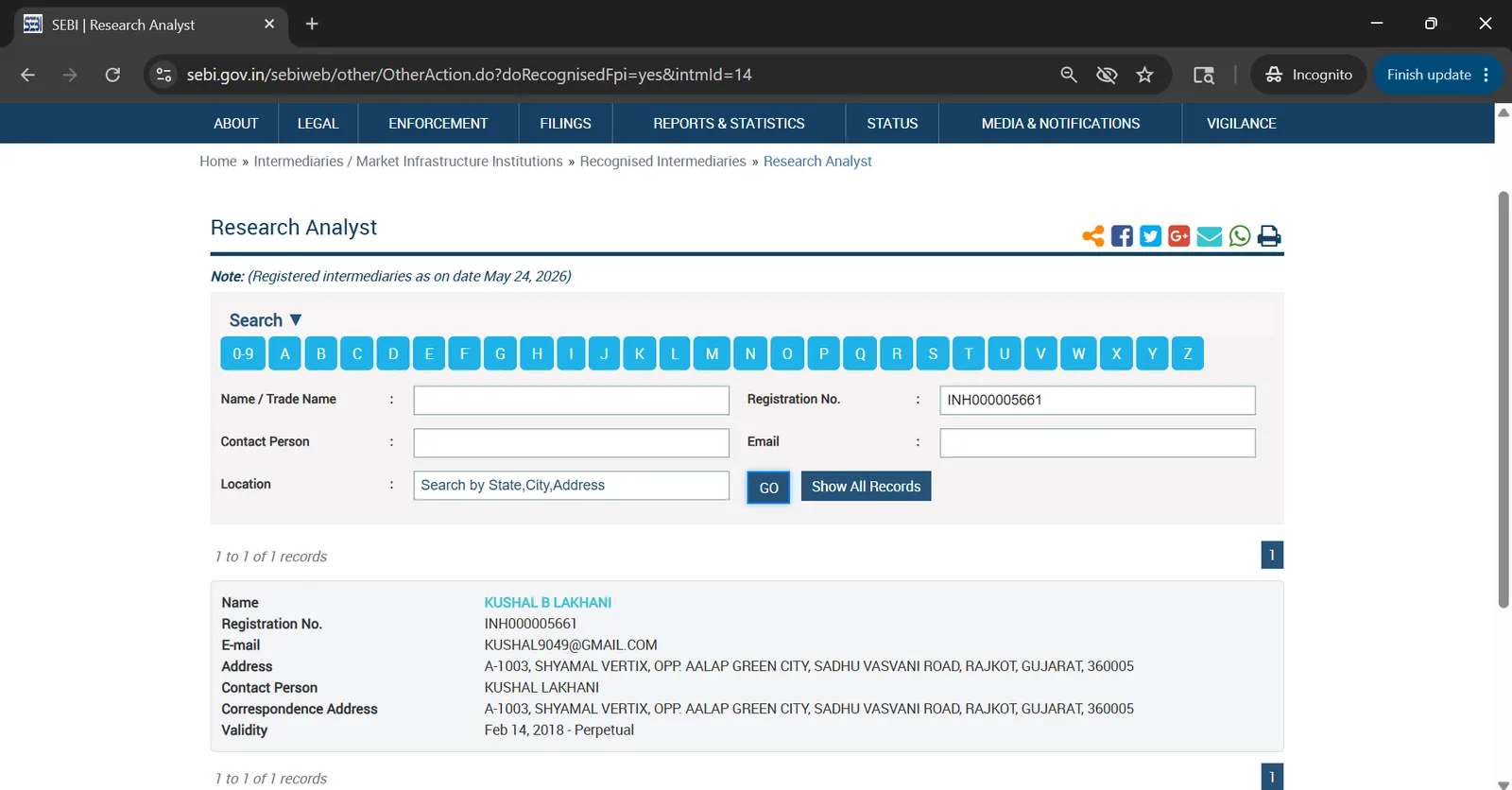
Paste the INH number into the search box. Hit enter.
You should see exactly one result, with the analyst's full registered name, registration date, and current status (active, suspended, or cancelled).
Step 4: Match the name and check the status
This is where most fakes fall apart. The Telegram channel may call itself 'Rakesh Kumar Stock Tips,' but the registration number it's flashing actually belongs to 'Suresh Patel & Associates.' That mismatch tells you everything you need to know.
Also check the registration status. If it says 'Cancelled' or 'Suspended,' that person was registered once but is no longer authorised. Walk away.
Step 5: Check for the SEBI disclaimer
On the analyst's actual communication — their website, their reports, their subscription page — look for the SEBI-mandated disclaimer block. It typically includes: registration details, a risk warning that investments are subject to market risk, a statement that recommendations don't assure returns, and a reference to SCORES (SEBI's grievance platform) for complaints.
This block is mandatory. Genuine RAs include it because they have to. Fakes either skip it entirely or copy a generic version that doesn't match their stated registration.
Five things a fake registration usually gets wrong
1. Wrong prefix — uses INA, INZ, or some made-up code instead of INH for an RA.
2. Wrong digit count — looks 'official' but the digits don't match SEBI's nine-character format.
3. Number isn't searchable on sebi.gov.in — most common giveaway.
4. Number belongs to a real but different person — 'piggybacking' on a legitimate RA's identity.
5. Status shows as cancelled or suspended — they were once registered, then deregistered, but kept operating.
Why this matters more in 2026 than ever before
In February 2026, SEBI made it mandatory for every regulated entity to display its registered name and SEBI registration number on its social media handles, and at the start of every securities-related post. Meta started enforcing similar verification on Indian investment ads from mid-2025. The regulators are explicitly trying to make verification easy for retail investors — but only if you actually do the check.
The 60 seconds you spend verifying a Research Analyst is the cheapest insurance you'll ever buy. Compare it to the months it takes to recover from a Telegram pump that wiped out your trading capital.
The shortcut: use a marketplace that pre-verifies
If 60 seconds still feels like too much, that's exactly why curated marketplaces exist. On Kuberhunt, every listed Expert is checked against the SEBI registry before going live. The registration number is shown on every profile, so you can do the cross-check in 10 seconds, not 60. You're not avoiding the verification — you're letting the platform do the heavy lifting first.
Either way, the principle is the same: never pay for stock recommendations from anyone whose SEBI registration you haven't seen with your own eyes.
Browse 100% verified SEBI-registered Experts on Kuberhunt → kuberhunt.com/experts
FAQs
How long does SEBI take to register a new Research Analyst? Typically 30-90 days from application, depending on documentation completeness and queries from RAASB (the BSE-administered supervisory body for RAs).
Can I verify a research analyst without their registration number? Yes — the SEBI intermediaries search also accepts the analyst's name. But the registration number is always more reliable, since multiple analysts may share common names.
What's the difference between SEBI registration and NISM certification? NISM certification (specifically NISM Series XV-A) is a qualification exam an RA must pass. SEBI registration is the authorisation to actually offer paid research services. You need both — but only the latter makes them legally allowed to charge clients.
Can a SEBI-registered RA still scam me? Misconduct is rare but possible. The difference is recourse — with a registered RA, you can file a complaint on SCORES and SEBI investigates. With an unregistered tipster, your complaint goes nowhere. Registration isn't a guarantee of integrity, but it's a guarantee of accountability.