
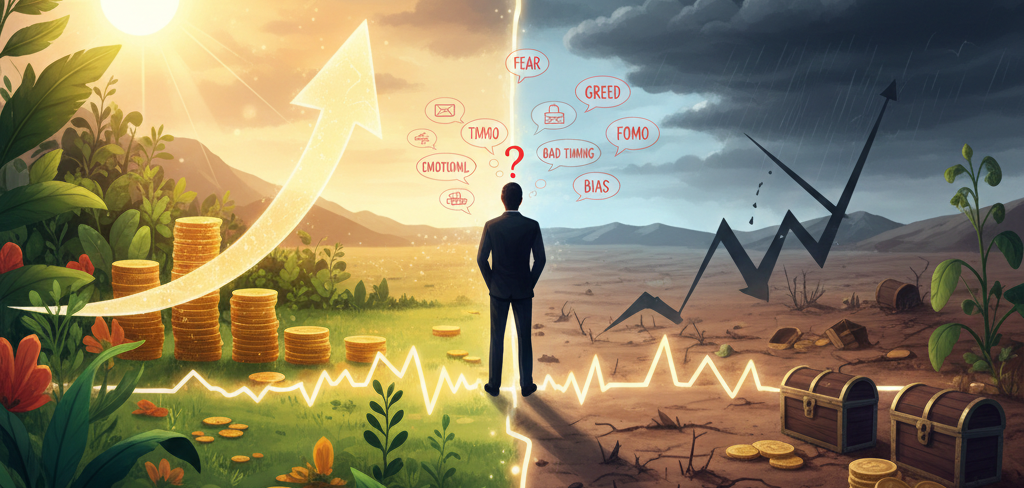

Over long periods, equity markets tend to move higher. Yet most individual investors fail to benefit meaningfully from this growth. This gap doesn’t exist because markets are unfair. It exists because
Over long periods, equity markets tend to move higher.
Yet most individual investors fail to benefit meaningfully from this growth.
This gap doesn’t exist because markets are unfair.
It exists because investing success depends more on behavior than selection.
The Return Gap No One Talks About
Across markets and cycles, the pattern remains consistent:
- Markets deliver reasonable long-term returns
- Investors earn significantly less
The difference is not knowledge or intelligence.
It is decision-making under uncertainty.
Common Behavioral Mistakes
Most investors unknowingly sabotage their own returns by:
- Entering after strong rallies
- Exiting during temporary corrections
- Switching strategies too frequently
- Reacting to headlines and short-term narratives
Each decision feels justified in isolation.
Collectively, they destroy compounding.
Decision Fatigue Is a Silent Killer
In today’s environment, investors are overwhelmed:
- Continuous market updates
- Social media opinions
- Constant performance comparisons
More information does not lead to better results.
It leads to more decisions and more mistakes.
Compounding Rewards Inactivity
Wealth creation in equities is not about constant action.
It is about staying invested during periods when action feels uncomfortable.
Missing a handful of strong recovery phases can permanently reduce long-term outcomes.
Ironically, these phases usually arrive right after fear peaks.
Why Structure Matters
Successful investing is less about predicting outcomes and more about controlling behavior.
Well-structured portfolios aim to:
- Reduce emotional decisions
- Limit unnecessary churn
- Maintain alignment with long-term goals
The objective is not excitement.
The objective is endurance.
Investor Takeaway
If your investing experience feels stressful, inconsistent, or reactive, the issue is rarely the market.
It is the absence of a clearly defined process.
My Closing Thought
Markets reward patience far more reliably than intelligence.
This belief forms the foundation of long-term, rules-based model portfolios built to help investors stay invested through full market cycles rather than fight them.
If this approach resonates with you, you already think like a long-term investor.